Different Fractals
 |
 |
 |
 |
Pascal's triangle is a pattern of numbers arranged in the shape of a triangle. It starts with a single 1 at the top. Each new row is made by adding the two numbers above it to get the number below. For example, the row after 1 becomes 1, 2, 1, because 1 + 1 = 2. The triangle shows many number patterns and is often used to find combinations in math and probability. Each row also matches the numbers you get when expanding something like “(a + b)” raised to a power. It's a simple but powerful way to explore patterns with math.
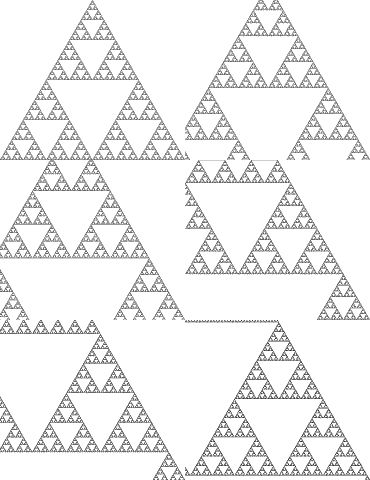
The Sierpinski triangle is a famous fractal named after the Polish mathematician Wacław Sierpinski, though similar patterns appeared in art and architecture long before his work. It begins with a single equilateral triangle, which is repeatedly subdivided into smaller triangles by removing the central one in each iteration. This process creates a self-replicating, infinitely detailed pattern where each smaller triangle mirrors the whole. The Sierpiński triangle beautifully demonstrates the concepts of recursion, self-similarity, and infinite complexity within simple mathematical rules. It's often used to illustrate fractal geometry, computer graphics, and even natural patterns found in snowflakes and plants.
|
|
|
|